

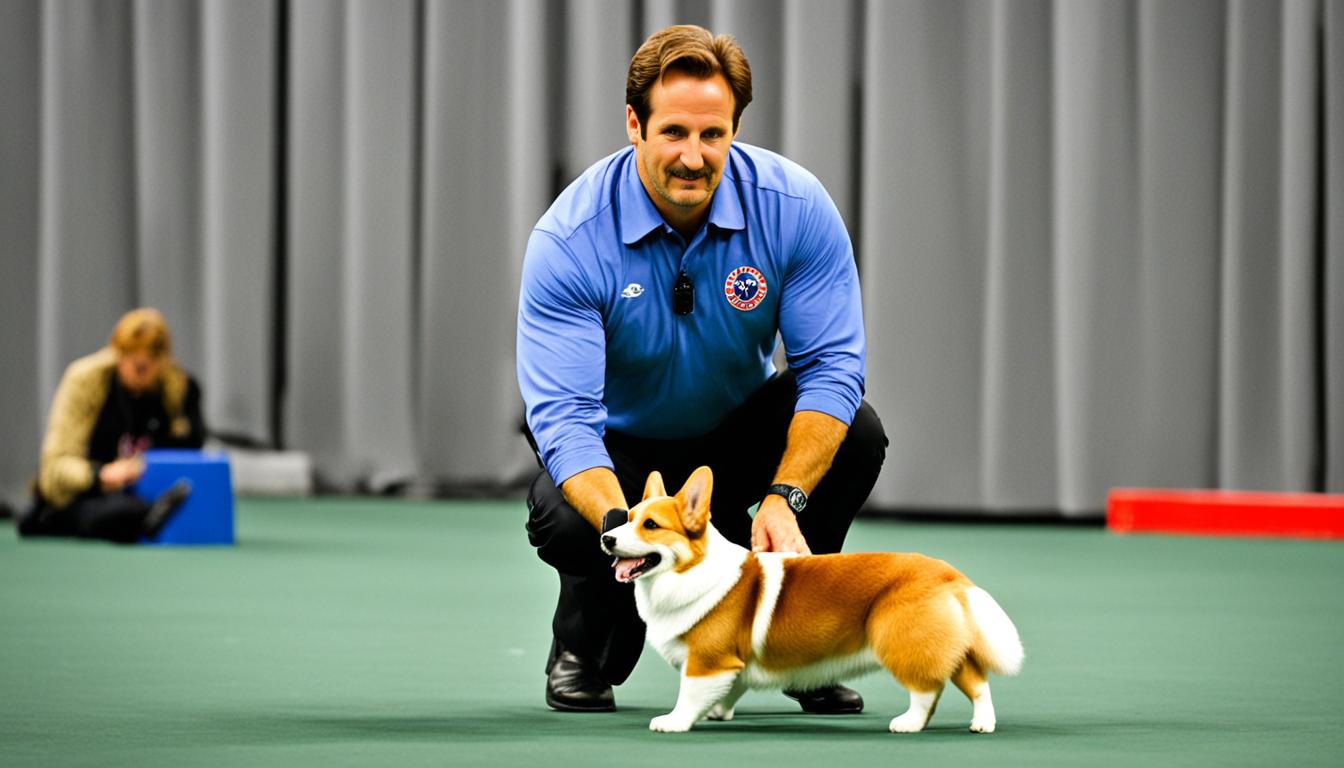

Have you ever seen a Pembroke Welsh Corgi perform in a competition? Their graceful moves and focus are captivating. It’s like they naturally know how to excel in obedience.
Training your Pembroke requires passion and a strong bond. It’s not just about winning. It’s about trust, respect, and working together.
You might already enjoy training with your Pembroke. Their intelligence and willingness to learn can be impressive. Or, you may be starting out, looking for ways to improve in competitions.
You’re in the right place for guidance. This guide offers knowledge, techniques, and advice. It’s your first step towards an amazing journey with your Pembroke Welsh Corgi.
Key Takeaways:
- Training your Pembroke for obedience competitions is a journey of passion and commitment.
- Building a partnership based on trust and mutual cooperation is essential.
- This guide will give you the knowledge and techniques to unlock your Corgi’s potential.
- Embark on an extraordinary adventure with your Pembroke Welsh Corgi.
- Stay tuned for expert tips, exercises, and strategies in the upcoming sections.
The Levels of Competitions
Dogs advance through different levels in competitive obedience. Each level has unique challenges and requirements. Let’s examine the levels of obedience contests:
1. Introductory
The introductory level is where dogs learn the basics of competitive obedience. The aim is to build foundational skills. It also boosts the dog’s confidence.
2. Pre Beginners
The pre beginners level adds more advanced exercises. Dogs and handlers work on bettering their obedience skills. They aim for higher accuracy.
3. Beginners
Beginners level requires dogs to show more accuracy and skill. Handlers work on improving communication and timing. This is to get consistent results.
4. Novice
Novice marks the first official competition level. Dogs need to master exercises like heeling and recalls. Handlers must show they can control and communicate well with their dogs.
5. Class A
In Class A, dogs face complex exercises like scent discrimination. The focus is on the dog’s performance fluency. Accuracy is critical at this level.
6. Class B
Class B brings advanced exercises, including directed retrieves. Dogs and handlers need to display excellent skills. They must prove their teamwork and high proficiency.
7. Class C and Championship Class C
Class C and Championship Class C are the top levels. Here, dogs show top-notch obedience and precision in complex tasks. These classes are for the most skilled teams.
As dogs move up levels, the exercises get tougher. They demand greater obedience and precision. Handlers must keep improving their training methods. This helps them excel in higher-level contests.
Looking for obedience training tips and techniques to improve your skills and prepare for dog competitions? Check out the next section for expert advice on advanced obedience training.
Exercises in Competitive Obedience
Competitive obedience is about a dog’s listening and training skills. As dogs move up in levels, the challenges get harder. They need strong training from the start.
In these contests, dogs do various key exercises:
- Heeling on a Lead and Off-Leash: Dogs stay in position and heel with or without a lead.
- Recall: They come right away when called.
- Retrieve: Dogs pick up an item and bring it back correctly.
- Sit and Down Stays: They stay in sit or down position, showing they can focus.
- Scent Discrimination: Dogs find one specific scent among many.
- Send Away: Sent to a spot, dogs wait there until called.
- Drop, Recall, and Distant Control: Dogs follow a drop command, come back, and show they can listen from afar.
Getting good at these tasks means learning lots of obedience skills. Both the handler and dog must trust each other to do them right.
Every level of competition adds new exercises. This means handlers and dogs need to keep improving. They face tougher tasks as they go.
Here’s a table explaining the exercises and what’s needed at each competition level:
| Competition Level | Key Exercises | Requirements |
|---|---|---|
| Introductory | Heeling, Recall, Sit and Down Stays | Basic obedience skills, focus, and control |
| Pre Beginners | Retrieve, Scent Discrimination | Learning scent work, more obedience skills |
| Beginners | Send Away, Drop, Recall | Listening over distances |
| Novice | All Above Exercises | Doing tasks off-leash, staying longer |
| Class A | Retrieve Over a Jump, Scent Discrimination With Distractions | Higher skills, staying focused around distractions |
| Class B | All Above Exercises | Handling complex tasks, reliable listening in tough spots |
| Class C | All Above Exercises and Additional Challenges | Top skills, perfect execution under stress |
| Championship Class C | Elite Exercises and Distractions | The best precision, focus, and performance |

Rules and Requirements
Competitive obedience competitions have their own rules and requirements. It’s essential to know these for success. Key requirements will be explored below:
1. Handling and Encouragement
In some classes, handlers can encourage their dogs. They use verbal cues, hand signals, and positive reinforcement. Yet, in advanced classes, this is limited. Handlers then rely more on training and the dogs’ understanding of signals.
2. No Food Treats
Food treats are not allowed in obedience competitions. Dogs must use their training and skills for exercises. This shows how vital consistent training is for reliable responses without treats.
3. Kennel Club Registration
To enter Kennel Club obedience contests, dogs need to be registered. They must be on the Breed or Activity Register. This ensures they meet breed requirements and follow Kennel Club competition rules.
Understanding these rules helps create a fair competition for everyone. Proper training and techniques prepare dogs well for these contests.

| Requirements | Details |
|---|---|
| Handling and Encouragement | Handlers can encourage their dogs during certain classes |
| No Food Treats | Food treats are not allowed during the exercises |
| Kennel Club Registration | Dogs must be on the Breed Register or Activity Register |
AKC National Obedience Championship
The AKC National Obedience Championship is a top event for obedience competitors. It shows the amazing obedience skills of dogs and their handlers.
This championship has classes for all levels, helping experts and newbies alike. It’s great for learning about the sport and the effort needed to compete.
The contest includes various exercises to test a dog’s obedience, focus, and skill. The judges look at how well dogs listen, perform, and work with their handlers.
“The AKC National Obedience Championship is an incredible event. It inspires both participants and spectators, showcasing the tremendous bond and teamwork between dogs and their handlers. It’s a testament to the dedication and hard work put into obedience training programs.” – Michelle Thompson, Obedience Trainer
Competing at the championship shows off a handler’s skill and their bond with their dog. It encourages more people to get into dog competitions. It highlights the value of training and learning more about obedience.
If you love dogs or the sport, the AKC National Obedience Championship is a must-see. You’ll be amazed by the talent of dogs and their handlers.
So, get ready and join the excitement at the AKC National Obedience Championship!
Levels of Obedience Classes
Obedience contests are split into three levels: Novice, Open, and Utility. Each level has its challenges and needs. Let’s look into each one more closely:
1. Novice Class
The Novice class is for dogs new to contests. It tests basic training and skills. The tasks include heeling with and without a leash, figure eight, standing for inspection, recall, and sitting and lying down for long periods.
2. Open Class
Dogs move to the Open class after mastering the Novice level. This level has harder tasks that mimic real-life situations. Tasks include jumping to retrieve, fetching a dumbbell, dropping on recall, and identifying scents.
3. Utility Class
The Utility class is the top level and for the most skilled dogs. Dogs show advanced obedience and focus. They perform directed jumps, scent discrimination using a specific object, directed fetching, and respond to hand signals.
Some contests also have optional classes. These help handlers and dogs prepare for tougher challenges. They are a bridge between the main levels.
Each class requires specific skills and tasks. Dogs must reach the standard in one level to move to the next. With hard work and training, dogs can climb through the ranks and face tougher contests.
| Obedience Class | Main Skills Tested |
|---|---|
| Novice | Basic obedience skills, recalls, stays, heeling |
| Open | Retrieve, scent discrimination, jumps |
| Utility | Directional work, scent discrimination, signals |

The image shows the effort and focus needed for advanced training. It highlights the commitment required to reach the top levels of obedience contests.
Scoring and Titles
In obedience contests, scores are very important. They show how well participants perform each task. Points get taken away for mistakes. This ensures participants reach high skill levels in obedience.
To win titles, dogs need to score high. They must get more than half of the points for every task. And, they need at least 170 points in total. This shows the dog is well-trained and obedient.
Titles are given at various levels. Dogs can earn different titles as they move up. These titles prove a dog’s skills and hard work. They show the dog’s training was successful.
Sample Title Table
| Level | Qualifying Score | Title |
|---|---|---|
| Introductory | 170+ | Introductory Obedience Title (IOT) |
| Pre Beginners | 170+ | Pre Beginners Obedience Title (PBOT) |
| Beginners | 170+ | Beginners Obedience Title (BOT) |
| Novice | 170+ | Novice Obedience Title (NOT) |
| Class A | 170+ | Class A Obedience Title (COT-A) |
| Class B | 170+ | Class B Obedience Title (COT-B) |
| Class C | 170+ | Class C Obedience Title (COT-C) |
| Championship Class C | 180+ | Championship Obedience Title (COT-Ch) |
These titles honor both the dog and the handler. They show the effort put into training. They reflect the strong teamwork between the dog and their handler.

Benefits of Obedience Training
Obedience training offers many perks for dogs and their owners. It teaches more than just basic commands. It helps dogs learn good manners and behave better. It also stops problems like too much barking or jumping.
This training is not just physical but also good for a dog’s mind. It keeps their brains sharp and active. Dogs stay smart and lively.
It also makes the bond between dogs and their owners stronger. Through regular training, dogs learn to trust their owners. This builds a relationship based on respect and understanding.
Obedience training is more than competition prep. It makes life better for dogs and their owners.
You can choose basic or advanced training. Either way, the benefits last beyond the sessions. Trained dogs handle new situations well. They stay calm and confident.
Putting effort into training helps dogs in the long term. Well-trained dogs behave well, which makes them more welcome at events and in public places.
Successful training needs a fun and positive setup. Rewards and praise work well. They encourage dogs to do well in training. This lays the groundwork for more advanced training and competitions.
Pembroke Welsh Corgi Temperament and Training Tips
Pembroke Welsh Corgis are bold and smart, perfect for obedience contests. They need early socialization and training. Through good training, you can control their herding and guarding instincts.
Understanding Pembroke Welsh Corgi Temperament
This breed is alert and quick to learn, great for obedience contests. They love mental challenges and aim to please their humans. Still, they can be stubborn, which proper training can fix.
Training them with positive reinforcement works best. Treats, praise, and play make them want to do well. Being consistent and patient is key during training.
Essential Training Tips for Pembroke Welsh Corgis
Training a Corgi means focusing on important commands. Here are some useful tips:
- Recall: Start recall training early. Use positive rewards to encourage this.
- Leave It: Teach them to ignore distractions. This helps manage their herding behavior.
- Touch: Have them touch a target or your hand. It’s useful for keeping their attention.
- Loose Leash Walking: Train them to walk without pulling. Use positive reinforcements and redirection to achieve calm walks.
With these basic training tips, you can solve common issues and get your Corgi ready for contests.
Conclusion
Training your Pembroke for obedience contests needs your commitment and a good trainer’s help. A fun, positive method is key. To ready your dog for competitive obedience, follow a training program and use helpful tips. You’ll need to know the competition’s levels, tasks, and rules to win.
Obedience training does more than just get your Pembroke ready for contests. It improves their behavior too. Through this training, your dog learns key skills like heeling, coming when called, and staying put. This makes them behave better in different places. Also, it makes your bond with your dog stronger, improving trust and communication.
Always train with patience and stay positive. Celebrate the small wins and make training fun for both of you and your dog. With regular training and a skilled trainer’s advice, you and your Pembroke can do well in obedience contests. So, begin training for obedience now and see your dog excel in competitions!
FAQ
Can I train my Pembroke Welsh Corgi for obedience competitions?
When should I start obedience training with my Pembroke?
How can I start training for obedience competitions?
What are the different levels of competitive obedience?
What exercises are included in competitive obedience competitions?
What rules and requirements apply to competitive obedience competitions?
What is the AKC National Obedience Championship?
What are the different levels of obedience classes?
How are obedience competitions scored?
Source Links
- https://www.akc.org/expert-advice/sports/dog-obedience-competition-101/
- https://www.dogster.com/dog-training/corgi-training
- https://www.welshcorgileague.org/obedience-2/

Carlos is the passionate founder and primary author behind “CorgisCorner.com,” a website dedicated to all things related to the beloved Corgi breed. Born and raised in a small town known for its strong sense of community and love for animals, Carlos developed a deep affection for Corgis from a young age. This love was sparked by his childhood companion, a spirited and loyal Corgi named Toby, who was a constant source of joy and friendship.