

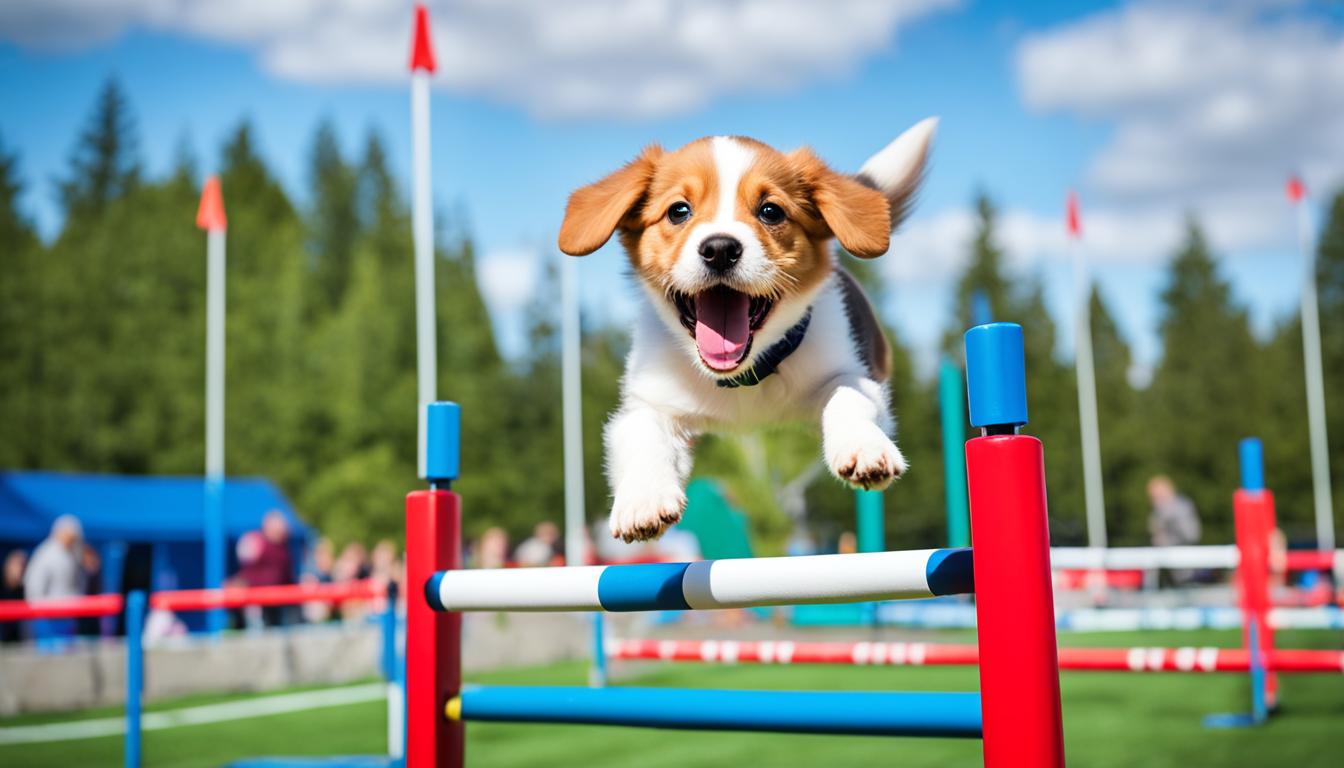

Are you ready for a fun adventure with your dog? Agility training is perfect, whether you’re a new or seasoned dog owner. It boosts your dog’s physical and mental health. Plus, it strengthens the bond between you both.
Picture your dog nailing an agility course. They jump, weave, and tackle obstacles with ease. Watching your dog’s agility grow will fill you with pride and joy.
But starting can be tough. How do you ensure a rewarding agility journey for your puppy? This article offers expert advice, simple training drills, and key tips. We’ll help kick-start your pup’s agility adventure.
Key Takeaways:
- Introducing agility training to your puppy can foster a strong bond and provide mental and physical stimulation.
- Follow expert tips and practical exercises to set your puppy up for success in agility.
- Start with foundation training and gradually introduce basic agility exercises appropriate for your puppy’s age and abilities.
- Expose your puppy to new experiences while taking it slow to ensure they develop confidence and self-control.
- Set achievable goals, enjoy the journey, and prioritize your puppy’s safety at all times.
Choosing the Right Puppy for Agility
Choosing a puppy for agility training means thinking about many things. You want a puppy that fits your goals and lifestyle. It’s important to pick one that matches your training style. Different breeds and personalities do well in agility, so finding the right match is key.
Breed considerations for agility
Some breeds are stars in agility, known for their energy and smarts. For example, Border Collies, Australian Shepherds, and Belgian Malinois are great choices. They’re quick, clever, and love to work. These breeds are excellent for those aiming at competitive agility.
Not everyone wants to compete, though. For fun and friendship, many breeds work well. Labs, Golden Retrievers, and Shelties are perfect for lighter agility activities. Such dogs are easy to train and love to play, making them great for casual training.
Puppy temperament and agility
A puppy’s personality is huge when it comes to agility. Even within agile breeds, puppies differ. Look for one that’s smart, focused, and likes to learn new things. Being confident and eager to please is also important.
Selecting the right agility dog
Choosing an agility puppy needs some homework. Even within one breed, puppies can vary. Some might have a herding focus, while others lean towards agility. Pick a healthy puppy whose character fits with how you train and live. This will help build a strong, happy team for agility fun.
Choosing a puppy for agility is personal. Spend time meeting different puppies and talk to their breeders. You might also want to get advice from a trainer. With the right preparation, you’ll find the perfect puppy for an exciting agility adventure.
| Breed | Agility Style | Temperament |
|---|---|---|
| Border Collie | Competitive Agility | Highly intelligent, energetic, and focused |
| Australian Shepherd | Competitive Agility | Intelligent, versatile, and eager to please |
| Belgian Malinois | Competitive Agility | Driven, athletic, and highly trainable |
| Labrador Retriever | Recreational Agility | Friendly, versatile, and trainable |
| Golden Retriever | Recreational Agility | Friendly, intelligent, and adaptable |
| Shetland Sheepdog | Recreational Agility | Smart, trainable, and agile |
Foundation Training for Agility Puppies
Agility training for puppies starts with the basics. Begin training early, around 8 weeks old. This sets your puppy up for agility success. It’s about building a strong bond and teaching basic behaviors needed for agility.
Understanding your puppy’s play style is key in foundation training. It allows you to tailor the training. Whether motivated by toys, treats, or praise, knowing what drives your puppy makes training more effective.
Teaching basic behaviors is essential. Start with foundational obedience commands like sit, down, and kennel. These are the building blocks for advanced agility skills. A solid foundation is crucial for later success in agility.
Foundation training for agility puppies isn’t much different from training family dogs. Both aim to create a happy and confident dog. However, agility training focuses more on behaviors like targeting and weaving.
Benefits of Foundation Training for Puppy Agility
Early foundation training shapes behavior and instills good habits. This prepares them for agility success and helps them be obedient dogs. The benefits of starting foundation training early are significant.
This training is the groundwork for advanced skills. It boosts body awareness, coordination, and control. These are vital for agility obstacles. Plus, the bond and trust built during training strengthen your partnership in agility.
A well-trained puppy is more likely to excel in agility and enjoy training. Early positive training experiences build confidence. This leads to a confident and successful agility dog.

Foundation training prepares your puppy for challenging agility training and courses. Be consistent, patient, and have fun. Your puppy’s exciting agility journey is just beginning!
Introducing Agility Training to Your Puppy
It’s exciting to start your puppy on agility training. Even at 8 weeks old, they can begin basic exercises. These activities match their young age and growing physical abilities.
Early exercises lay the groundwork for agility skills. They help puppies become confident and skillful in agility tasks. Now, let’s look at some beginner exercises for your new buddy:
- Going around the wing of a jump: Teach your puppy to circle around a jump’s wing. You can raise the height as they get more confident.
- Lap turns, tandem turns, and flick on the flat: Get your puppy used to different turns. Show them how to do lap turns, tandem turns, and quick flicks.
- Rear end awareness: Teach your puppy to be aware of their back legs. Have them pivot or step over poles to strengthen their rear muscles.
- Sending the puppy ahead to a preplaced reward: Work on cues that make your puppy move forward to a reward. This trains them to follow directions on agility courses.
Keep training fun for both of you. Use treats and praise to encourage and reward their progress. Celebrate every little win and keep building their skills.
Building a Strong Foundation
Introducing basic agility tasks builds a solid foundation for your puppy. These exercises boost their physical skills, mental sharpness, and obedience.
Like children who learn to walk before running, puppies must master basic skills for agility success.
Watching your puppy’s progress helps customize their training. Focus on areas that need work. Patience is key, as each puppy learns at their own speed.
Make sure your puppy enjoys their agility training. A happy experience boosts their love for agility and strengthens your bond.

| Benefits of Introducing Agility Training Early | Key Takeaways |
|---|---|
| 1. Builds physical coordination and balance | • Start agility training as early as 8 weeks old |
| 2. Develops mental stimulation and focus | • Begin with basic exercises appropriate for their age and abilities |
| 3. Fosters the bond between you and your puppy | • Teach exercises like going around a jump wing and performing different turns |
| 4. Creates a positive and enjoyable training experience | • Work on rear end awareness and sending the puppy to a preplaced reward |
Setting Your Puppy Up for Success in Agility
Getting your puppy ready for agility involves planning. It’s important to expose them to new things and pace the training.
It’s crucial to expose your puppy to new experiences early on. Let them discover various environments, surfaces, and stimuli. By doing so, you’re building their confidence and preparing them for agility’s challenges. Take them to different parks and let them feel different surfaces. Also, introduce them to new sounds and sights under your watchful eye.
Building confidence is key in agility. Getting your puppy used to new things helps them feel secure. This makes navigating agility courses easier for them.
Taking it slow in agility training is also vital. Rushing can overwhelm your puppy and set back training. Instead, focus on basic skills that form a strong foundation for agility success.
Start with simple commands like sit, stay, and come. These are crucial for navigating agility courses. Then, slowly introduce agility-specific tasks and obstacles. Make sure these are suitable for your puppy’s age and physical abilities. This gradual training helps your puppy learn necessary skills without feeling rushed.
It’s essential to understand that each puppy is unique. Listen to your puppy and let them advance at their own speed. Some may learn agility quickly, others may need more time. Being patient and understanding is important for their success in agility.
By introducing your puppy to new experiences and pacing their training, you’re setting them up for agility success. This approach gives them a strong start on their agility journey.

| Benefits of Exposing Your Puppy to New Experiences | Benefits of Taking It Slow in Agility Training |
|---|---|
| Builds confidence | Prevents overwhelm |
| Prepares your puppy for challenges | Builds a strong foundation |
| Develops adaptability | Ensures skill and behavior understanding |
Goals and Competition with Your Puppy
Starting your puppy on an agility journey? Set both short and long-term goals. It’s key to have big dreams yet enjoy learning with your puppy. Aiming for the FCI World Championships might be a dream. But every puppy’s journey is different.
Build a strong foundation and grow your bond. Keep your goals in sight as you move forward.
Short-Term Agility Goals
Short-term goals help track progress and keep motivation high during training. They are the steps toward bigger achievements. For instance, short-term goals could be:
- Mastering basic obedience commands
- Confidently navigating common agility obstacles
- Developing strong communication and teamwork
- Earning beginner-level agility titles
Long-Term Agility Goals
Long-term goals are your ultimate aspirations in your puppy’s agility career. Achieving them might take months or years. They give you a long-term vision. These goals can include:
- Competing in regional or national agility competitions
- Earning advanced-level agility titles
- Qualifying for prestigious agility events
- Representing your country at international agility championships
Reaching your long-term goals demands dedication and constant learning. See each challenge as a chance to grow with your puppy.
“The joy in agility lies not only in the achievement of goals but in the bond and partnership you develop with your puppy. Cherish the moments, enjoy the progress, and celebrate every small victory.”

Combining short and long-term goals sets the stage for agility success. Remember, each journey is unique. The joy comes from the process with your furry friend. Focus on a strong foundation, your puppy’s growth, and your bond. Together, tackle agility challenges and make memories.
| Short-Term Goals | Long-Term Goals |
|---|---|
| Mastering basic obedience commands | Competing in regional or national agility competitions |
| Confidently navigating common agility obstacles | Earning advanced-level agility titles |
| Developing strong communication and teamwork | Qualifying for prestigious agility events |
| Earning beginner-level agility titles | Representing your country at international agility championships |
Pre-Agility Training for Puppies
Getting puppies started on pre-agility training is a great first step towards agility success. Through simple exercises, they learn essential skills. These foundations are crucial for more advanced training later on.
Beginner Agility Exercises for Puppies
Introducing puppies to agility exercises improves their balance, confidence, and coordination. Start with these beginner-friendly exercises:
- Going under chairs and low tables: Teach your puppy to navigate tight spaces by going under furniture. It boosts their awareness and obstacle-handling skills.
- Crawling on their tummy under a bar in a doorway: A low-set bar helps puppies learn to crawl, building core strength and control.
- Hopping into and out of boxes: Use boxes to teach jumping in and out. It’s great for their jumping ability and precision.
- Hopping onto and off of low obstacles like rocks or chairs: Getting puppies used to obstacles like rocks or chairs enhances their balance and adaptability.
Start with simple exercises that match your puppy’s age and health. Slowly make them harder as your puppy improves.
Pre-Agility Props for Puppies
Using pre-agility props helps puppies get used to future agility challenges. Check out these props for training:
- Weaving poles: Teach weaving with an easy method. It sharpens their coordination and agility.
- Tunnels: Get a puppy-sized tunnel. Encourage your puppy to explore and move through it, boosting their speed and confidence.
- Jumps at a low height: Start with low jumps for your puppy. Add more as they get better at it.
These tools prepare your puppy for agility obstacles in a safe way.
| Exercise | Benefits |
|---|---|
| Going under chairs and low tables | Develops body awareness and obstacle navigation skills |
| Crawling on their tummy under a bar in a doorway | Strengthens core muscles and improves body control |
| Hopping into and out of boxes | Enhances jumping and landing skills |
| Hopping onto and off of low obstacles like rocks or chairs | Improves balance and surface navigation |
| Weaving poles | Develops coordination and footwork for weaving |
| Tunnels | Familiarizes puppies with crawling through tunnels |
| Jumps at a low height | Enhances jumping skills in a controlled setting |
The Benefits of Pre-Agility Training
Pre-agility training is the perfect starting point for puppies. It helps with their coordination, balance, and confidence. These are all key for doing well in agility.
Make sure training is fun and upbeat. Celebrate the small wins and always look out for your puppy’s safety. Getting advice from professional trainers is a good idea. Enjoy watching your puppy get better at agility.
Building Confidence and Self-Control in Agility Puppies
Agility training is great for puppies. It builds their physical skills and confidence. Through tackling new tasks and beating them, they feel proud. This boosts their self-belief. Keeping training positive is crucial for growing their confidence.
“Agility training provides an opportunity for puppies to step out of their comfort zones and overcome obstacles, which builds their confidence,” says expert dog trainer and agility enthusiast, Sarah Johnson.
Self-control is key for agility puppies. It’s taught through special exercises. Puppies learn to delay gratification, which helps in agility and life. Exercises like waiting for a treat teach this patience well.
Training them to stay on their bed until told otherwise is also beneficial. It teaches them to be patient.
Crate games can improve self-control. Puppies wait calmly, which boosts focus and impulse management. The “It’s Yer Choice” game helps, too. They learn to wait for a command to get a treat. This boosts their listening skills.
“Building confidence and self-control are essential for agility success. With consistent training and positive reinforcement, puppies can develop these important qualities that will serve them well in their agility journey,” emphasizes Sarah.
Introducing New Surfaces for Agility Puppies
Training agility puppies in diverse environments is key for their growth. It’s important for them to experience different surfaces. On the agility course, they will find teeters, dog walks, and tables that feel different.
Introducing puppies to new surfaces builds their confidence. This process is called surface desensitization. It prepares them to face different agility obstacles. They learn on surfaces like crinkly tarps, various stairs, and slippery floors.
It’s crucial to let puppies learn new surfaces at their own speed. Use positive rewards like treats, toys, or praise to encourage them. As they get used to each surface, gradually make the tasks harder by adding movement or height.
Each puppy is different and will respond differently to new surfaces. Watch their reactions closely and adjust your methods as needed. Surface desensitization training helps them master any agility challenge confidently.
Benefits of introducing new surfaces to agility puppies:
- Builds confidence and adaptability
- Prepares puppies for different agility obstacles
- Enhances their problem-solving skills
- Develops their proprioception and body awareness
- Strengthens the bond between you and your puppy
Adding surface desensitization to your puppy’s training helps them succeed in agility. It lets them face new challenges and grow their skills with confidence.
Teaching Basic Behaviors for Agility Puppies
To get your agility puppy ready for success, start with basic obedience behaviors. These skills are the foundation for their behavior and discipline. They help in both their agility training and overall behavior.
Recall training is key for every agility puppy. It makes sure your puppy comes when called, important in agility courses. Start recall training in a safe area by calling their name with excitement. When they come, give them rewards like treats or toys. You can make it harder by training in different places and adding distractions.
Teaching your agility puppy basic directional cues like “right” and “left” is also important. These cues help guide your dog through agility courses. Introduce these cues during regular training sessions. Begin on the ground and later incorporate them into agility training. Use hand signals or verbal cues with rewards to reinforce these commands.
It’s crucial to teach your agility puppy basic obedience behaviors such as sit, down, and stay. These commands are essential for starting courses and keeping your puppy safe. Use positive methods like treats and praise to encourage your puppy. This will help them understand and follow these commands.
Table 10: Basic Behaviors for Agility Puppies
| Basic Obedience Behaviors | Importance |
|---|---|
| Recall Training | Ensure prompt responses during agility courses. |
| Directional Cues | Guide your dog accurately through agility courses. |
| Sit, Down, and Stay | Promote safety and discipline during training. |
Teaching these basic behaviors gives your agility puppy a strong start. Make sure training is fun and rewarding for them. With patience and positive reinforcement, your puppy will learn the needed skills for agility sports.
Conclusion
Starting your puppy on agility early has many pros. It builds a strong bond and confidence. Plus, it teaches them key skills for agility success. By working on a good foundation and achievable goals, you both can enjoy this journey.
Getting your puppy ready for agility needs patience and hard work. Always keep your puppy safe and ask experts for advice when needed. Every puppy moves at their pace, so go slow. Early training sets them up for fun and success in agility.
Don’t wait to begin agility training with your puppy. It improves their physical skills and strengthens your bond. You’ll make lasting memories as you learn together. Celebrate your wins and enjoy the journey of agility with your puppy.
FAQ
What should I consider when choosing a puppy for agility training?
When should I start foundation training for my agility puppy?
What are some basic agility exercises I can start with for my puppy?
How can I set my puppy up for success in agility?
What goals should I set with my puppy in agility?
What activities can I do to develop my puppy’s agility skills?
How can I build my puppy’s confidence and self-control in agility?
How can I introduce new surfaces to my agility puppy?
What basic behaviors should I teach my agility puppy?
What are the benefits of early agility training for puppies?
Source Links
- https://www.akc.org/expert-advice/training/tricks-training-preparing-puppy-for-agility/
- https://app.oneminddogs.com/article/How-To-Set-Your-Puppy-Up-For-Success-In-Agility/
- https://www.poodleforum.com/threads/puppies-and-jumping-and-more-pre-agility-questions.111361/

Carlos is the passionate founder and primary author behind “CorgisCorner.com,” a website dedicated to all things related to the beloved Corgi breed. Born and raised in a small town known for its strong sense of community and love for animals, Carlos developed a deep affection for Corgis from a young age. This love was sparked by his childhood companion, a spirited and loyal Corgi named Toby, who was a constant source of joy and friendship.