

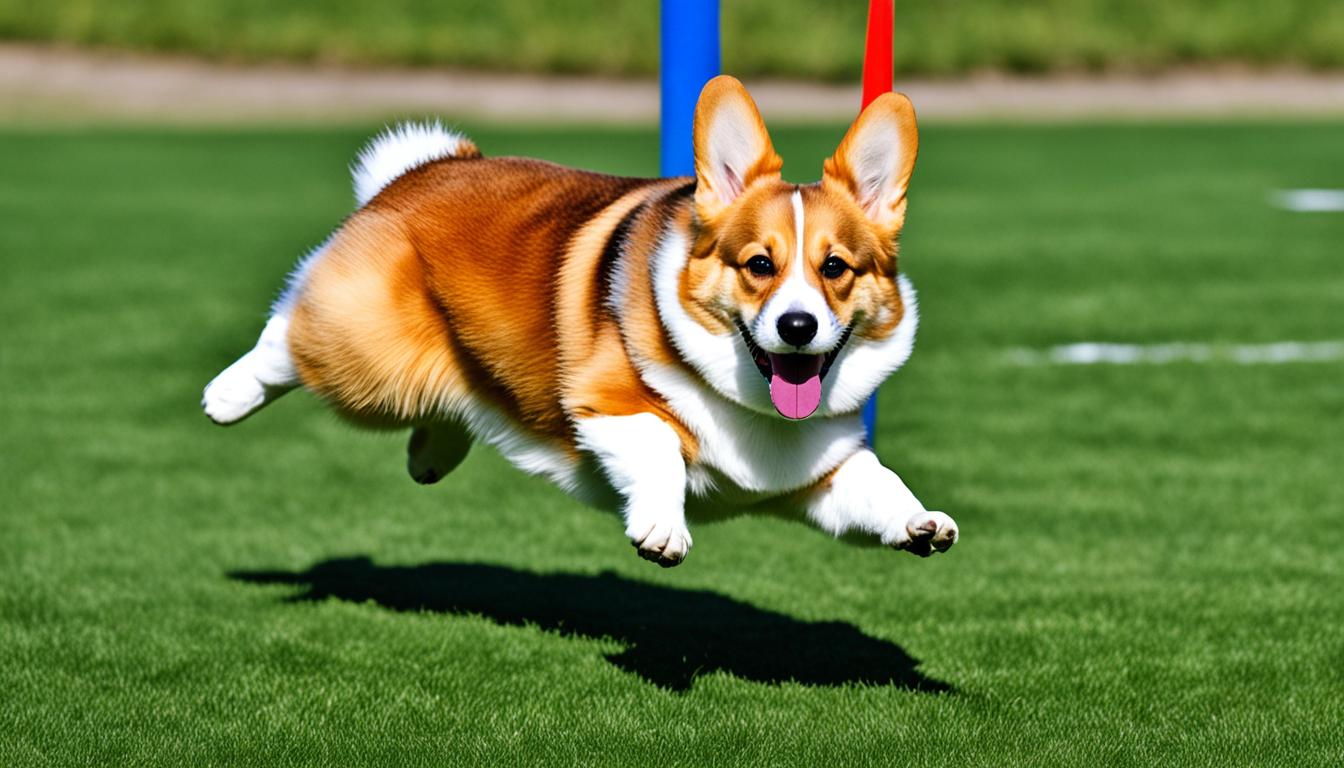

Are you ready to showcase your Pembroke Welsh Corgi’s skills in obedience trials? You’re in the right place! I’m excited to share, as a dog lover and obedience fan, the thrill of competing in these events.
Imagine this: It’s a clear morning, and you both stand ready in the ring, hearts beating fast. Your Corgi, right beside you, can’t wait to impress and make you proud. The strong connection between you two comes from endless training and trust. Now, it’s your moment to shine together.
Dog obedience contests are about more than just winning. They celebrate the deep bond you share with your pet. They honor the hours spent together, both teaching and learning.
Yet, winning is indeed sweet. It means your hard work and training methods are on point. Now, let’s explore key tips and strategies to ace Pembroke Welsh obedience trials. We’ll talk training methods and how to win, ensuring your success.
Key Takeaways:
- Training and competing in obedience trials foster a strong bond between you and your Pembroke Welsh Corgi.
- Winning combines hard work, smart training, and strategic competition moves.
- Victory in these trials celebrates your unique partnership with your dog.
- These essential tips will help up your chances at achieving greatness.
- Always consider your dog’s happiness and well-being during training and competition.
Participating in the Good Citizen Dog Scheme
The Good Citizen Dog Scheme is amazing for dogs and their owners. It teaches your corgi good manners and obedience. With more than 1700 groups across the UK, it’s a fun way to train your pet. You also get to earn rewards.
This scheme has levels like Puppy, Foundation, Bronze, Silver, and Gold. Each level teaches your dog how to behave and listen. You’ll go to classes every week. This helps your dog learn and make friends.
“The Good Citizen Dog Scheme is great for getting into competitive obedience. It builds skills in a friendly way.” – Jane Smith, a pro dog trainer
Joining the Good Citizen Dog Scheme is the first step in competitive obedience. You learn a lot as you move up the levels. Your corgi learns to be disciplined and to listen. This gets you ready for bigger challenges.
Rewards and Achievements
Getting awards in the Good Citizen Dog Scheme is thrilling. You get certificates and rosettes for passing each level. It shows how hard you and your corgi have worked. Plus, it might make you want to try even harder in future contests.
| Award Level | Requirements |
|---|---|
| Puppy | Basic commands and socialization |
| Foundation | Advanced obedience skills |
| Bronze | Complex exercises and controlled behaviors |
| Silver | Demonstration of exceptional obedience and reliability |
| Gold | High-level obedience and demonstration of outstanding skills |
The Good Citizen Dog Scheme helps you and your corgi get better. Each level brings new challenges and learning. You’ll see your dog’s behavior improve a lot.
Being part of the Good Citizen Dog Scheme has lots of perks. It gives a strong start in obedience contests. It also makes your relationship with your corgi stronger. It teaches them to behave. By joining, you’re helping your corgi be the best it can be in competitions.
Levels of Progression in Obedience Trials
Obedience trials offer a way for dogs and their handlers to show their skills. Each level has its own set of challenges. We will look at what these levels include.
1. Introductory and Pre-Beginner Classes
The journey starts with introductory and pre-beginner classes. These classes are for those new to obedience training. Participants learn the basic skills needed for competition.
2. Beginners and Novice Classes
After the introductory classes, participants move to beginner and novice levels. More advanced exercises are introduced. They test the dog’s obedience and the handler’s communication skills.
3. Class A, Class B, and Class C
Once the beginner and novice levels are mastered, it’s on to Class A, B, and C. These levels have tougher exercises and stricter judging. Both the dog and handler need to be very precise.
4. Championship Class C
The top level is the championship class – Class C. Competitors at this level show off top-notch obedience. It represents years of work, dedication, and a love for the sport.
Knowing which class you can enter is key. Start in the lowest class you’re eligible for. You can also enter one more class. Keeping track of wins and joining leagues can highlight your progress.
Your corgi must be registered with the Kennel Club for official competitions. This ensures fairness for all.

Starting your obedience trial journey means facing new challenges. Stay dedicated to training, enjoy learning, and have fun competing. Good luck in the world of competitive obedience!
Competitive Obedience Exercises
To be great in obedience trials, mastering various exercises is key. These tests measure a dog’s obedience and performance, becoming tougher at higher levels. Each one checks how accurate and well the dog performs, highlighting the need for handlers to execute tasks precisely and talk effectively with their dogs.
Here are the main exercises in competition:
- Heel work: The dog must walk closely by the handler’s side, with or without a leash. It shows the dog’s ability to mimic the handler’s moves.
- Recalls: In this test, the dog has to come when called. It looks at how quickly and accurately the dog returns.
- Retrieves: This one is about fetching an object like a dumbbell on command. It checks if the dog is eager to fetch and how well it delivers it back.
- Sit and Down stays: These show if the dog can stay seated or lying down when asked, even if the handler is far away. It tests the dog’s patience and discipline.
- Scent discrimination: The dog has to pick out and bring back a handler-scented item from a bunch of similar ones. It’s a test of the dog’s sniffing and choosing skills.
- Send away: Here, the dog is asked to run straight out from the handler. It sees how focused and controlled the dog is when moving in a set direction.
- Drop and recall: This checks if the dog can lie down and then come when called right after. It shows the dog’s quick reaction and trustworthiness.
- Distant control: The dog must follow commands from afar. It tests the dog’s attention and how well it obeys distant orders.
Keep in mind that rules change based on competition level. At higher levels, such as championships, handlers may not talk to their dogs much. This tests the dog’s obedience and self-discipline.
| Exercise | Focus | Skills Tested |
|---|---|---|
| Heel work | Attention and precision | Following handler’s movements |
| Recalls | Responsiveness | Promptly returning to the handler |
| Retrieves | Willingness | Object retrieval and delivery |
| Sit and Down stays | Patience and control | Maintaining positions at a distance |
| Scent discrimination | Scenting abilities | Identifying and retrieving scented articles |
| Send away | Focus and control | Going straight and fast in a designated direction |
| Drop and recall | Quick response | Dropping on command and immediate recall |
| Distant control | Attentiveness | Following commands from a distance |

These challenges require teamwork between handler and dog, showcasing their training and bond. By working on these exercises, handlers and dogs can get better at obedience trials and up their chances of winning.
Basics of AKC Obedience Competitions
AKC obedience competitions are great for training well-behaved dogs. They have three levels: Novice, Open, and Utility. Each level has its own set of challenges and exercises.
In Novice, dogs show basic obedience skills like heeling and staying. When moving to Open, they face harder tasks. This includes retrieving things and jumping over hurdles.
Utility is the top level, testing advanced skills like scent work. Handlers need to be very precise at this stage.
To join AKC obedience trials, your dog needs to be over 6 months with an AKC number. Judges at these trials check the dogs’ performance. They give points based on how well the exercises are done.
These trials are a way to show off your dog’s training and compete with others. It also helps strengthen your bond with your dog.
“AKC obedience competitions give dog owners a chance to show how well their dogs are trained. It’s a competitive but supportive environment.” – Jane Smith, AKC Obedience Competitor
These competitions let you see how your dog improves. You’ll get feedback from judges and meet other dog lovers.
Competing in the AKC National Obedience Championship is special. It lets you show your dog’s skills nationally against the best. It’s an honor to qualify and compete.
Now, let’s look at what dogs and handlers need to do at each level:
| Level | Exercises |
|---|---|
| Novice |
|
| Open |
|
| Utility |
|
Each exercise checks the dog and handler’s ability to perform perfectly. Practice a lot on these exercises to do well in competitions.

Remember, these competitions are more about bonding with your dog and enjoying their achievements. It’s important to enjoy this experience together!
Scoring and Titles in Obedience Trials
Scoring in obedience trials is key to judging a dog’s skill. Points get taken off for errors during the exercises. This method makes sure dogs and handlers meet a strict standard.
“Scoring high in obedience trials is a testament to the handler and dog’s teamwork, training, and performance.”
A dog can get a top score of 200 points. But getting this perfect score is tough because the tasks are complex. Dogs need more than 50% of the points and at least a total of 170 to pass. This shows they have good obedience skills.
To win the Companion Dog Title at the Novice level, a dog must score three qualifying legs from different judges. Doing this proves the dog’s steadiness and skill in obedience.
“Qualifying for obedience titles is a testament to the hard work and dedication of both dogs and handlers.”
Obedience titles honor a dog’s success and the teamwork between the dog and handler. They mark the successful training and the ability to do tasks well and reliably.
Summary Table: Obedience Titles
| Title | Qualifications |
|---|---|
| Companion Dog Title | Three qualifying legs at the Novice level under different judges. |
| Utility Dog Title | Three qualifying legs at the Utility level under different judges. |
| OTCH – Obedience Trial Champion Title | 100 points from the Open B and Utility B classes, including at least one first-place win in each class. |
| UDX – Utility Dog Excellent Title | 10 additional qualifying scores in the Utility class after earning the Utility Dog Title. |
Getting obedience titles is a huge win for dogs and their handlers. It shows their commitment and how well they can do in trials. These titles are proof of their hard work, training, and connection.
Benefits of Obedience Training
Obedience training is key for dogs in competitions and for good behavior. It shapes their actions and improves their manners.
A well-trained dog makes a great companion that can go places with you. Training brings discipline, so your dog listens to you. This makes going out fun for both of you.
Training can prevent problems like too much barking or jumping on people. It teaches dogs right from wrong, encouraging good actions and stopping bad ones.
It also keeps their minds busy. Dogs like challenges and learning. Obedience training helps with this, keeping them happy and less likely to misbehave.
The bond between you and your dog grows stronger with training. It builds trust and understanding. Training with positive rewards makes your dog connect happily with you. This makes your bond deep and rewarding.
Obedience training is fun and brings you closer to your dog. It’s good for their mental and physical health. And, it’s a way for both of you to enjoy time together. It turns training into fun, shared moments.

Success in Rally and Obedience
Charlie MacMillan makes waves in rally and obedience contests. Known for his talent, Charlie has shown his skill time and again. He topped the Top Rally Dogs list in 2018 with Ace, his remarkable dog.
Charlie credits his unique training style, which focuses on play. He aims to nurture his dogs’ natural skills and eagerness. He believes in making training fun for the handler and the dog, crucial for rally success.
Rally requires teamwork between the dog and its handler. It differs from standard obedience, offering more interactive courses. Both the handler and the dog work together, going through a variety of tasks.
Through play-based training, Charlie connects with his dogs’ natural instincts. This method helps them stand out in competitions. It not only boosts their performance but also deepens their connection.
“Training dogs with play-based techniques creates a positive and engaging learning environment. It allows them to showcase their natural abilities and boosts their enthusiasm for training and competing.”
Training Philosophy for Rally and Obedience
Charlie MacMillan takes a unique approach to rally and obedience training. He focuses on using a dog’s natural strengths. His goal is to make training fun for both the dog and the handler. That’s why he uses play in his training, creating a happy learning space.
Training with play helps dogs use their natural instincts. This way, training becomes more effective and fun. Through this method, Charlie grabs the dog’s focus. He motivates them to give their best.
Charlie believes it’s crucial to teach things right from the start. This prevents confusion and errors. It helps the dog know what is expected of them. Clear instructions and rewards for the right actions build a solid base of skills.
Forming a strong bond between the handler and the dog is also key in Charlie’s philosophy. This bond is vital for good teamwork in competitions. Keeping the dog’s interest and bond strong leads to competition success.
“Training through play allows me to tap into my dog’s natural drive and motivation. Together, we build a strong partnership and enjoy every step of the training journey.”
Achieving Training Success Through Techniques
Charlie uses various techniques that match his training philosophy. He relies heavily on positive reinforcement with treats and praise. This approach links training with happy feelings, encouraging dogs to keep doing well.
He simplifies complex exercises into easier steps. This method helps dogs grasp what they need to do. It boosts their confidence. With steady practice, they advance to harder tasks and higher competition levels.
Charlie also focuses on keeping the dog’s mind active. Challenges keep their brains engaged. This ensures they stay keen and ready to learn more.
In essence, Charlie’s method centers on positivity, play, and utilizing a dog’s raw talent. It results in a positive and fun training experience. This approach not only preps dogs for competitions but also deepens the handler-dog bond.
Charlie MacMillan’s method is about using play, understanding dog behavior, and smart training to win in rally and obedience. By tapping into a dog’s innate abilities and making learning fun, he sets a positive tone. His clear communication, encouragement, and step-by-step training strengthen the handler-dog connection. This strategy leads to not just competition wins but also a stronger bond.
Training for Rally Competitions
Training for rally competitions needs a systematic approach. Start by breaking down exercises into smaller, manageable steps. This helps your dog build skills and confidence. Each rally exercise has unique requirements and scores. Let’s dive into the “Call Front – Finish Right or Finish Left – Forward” exercise to see why proper training is key.
For this exercise, your dog must learn to come and sit in front of you straight. You can use a method called “backing up” for this. By stepping back as your dog comes close, you help them sit correctly. Always reward your dog for getting it right. This reinforces their learning.
Keep your training sessions upbeat and supportive for your dog. By being consistent, communicating clearly, and using positive reinforcement, your dog will get better at rally competitions.
Rally Training Steps:
- Begin with basic obedience and focus exercises.
- Introduce rally exercises one at a time, breaking them into simpler steps.
- Guide your dog with clear verbal commands and hand signals.
- Increase difficulty by adding distractions or changing locations.
- Regular practice improves consistency and skill.
Training Tips for Rally Competitions:
- Use positive reinforcement to motivate your dog.
- Keep training fun and short to avoid burnout.
- Improve your handling skills for better communication.
- Attend workshops to learn from experienced trainers.
- Understand the exercises and scoring rules from rally groups.
- Try mock trials to prep for real competitions.
Training for rally competitions is a journey of patience, dedication, and connection. By using the right techniques, breaking exercises into steps, and staying positive, you’ll boost your chances of winning at rallies.
Focusing on Speed and Return in Rally Training
In rally training, it’s key to focus on a dog’s speed and how quickly they respond. Charlie, a rally expert, underscores the importance of a dog’s swiftness and agility for success. Training techniques exist to enhance both in dogs, whether they’re naturally speedy or need a boost.
Charlie suggests starting training early by walking ahead and keeping the dog at pace. This approach builds endurance and pushes the dog to stay swift. Consistently rewarding this behavior keeps the dog engaged and motivated.
If a dog tends to be slower, there are specific methods to help them speed up. These methods reward the dog for fast and correct responses to commands. Using positive feedback and making training fun helps slower dogs become quicker and more alert.
Return Training: Building Speed and Accuracy
Return training focuses on speed and precision in rally exercises. It teaches dogs to quickly rejoin their handler after a task. This technique is crucial for a disciplined performance.
Success in return training comes from clear signals and immediate rewards for fast returns. Using consistent commands and celebrating quick returns encourages this behavior. It teaches dogs that speed is beneficial.
This approach doesn’t just increase speed but also precision as dogs learn to comeback without delay. Through practice, they get better at performing tasks and moving smoothly between them.
“Return training is a powerful tool to enhance a dog’s performance in rally. It teaches the dog to respond quickly and accurately, resulting in a seamless flow between exercises.” – Charlie
Improving Rally Obedience Skills
Speed and return training are crucial for better rally obedience skills. By using these strategies, dogs become more agile, attentive, and impressive in competitions.
The aim is to maintain the speed of fast dogs and increase the speed of slower ones. With regular practice, encouragement, and keeping the dog spirited, handlers can develop excellent rally obedience skills.
Focusing on speed, return training, and consistent practice helps dogs excel at rally competitions. Quickness and responsiveness not only improve performance but also highlight the teamwork between handler and dog.
| Rally Training Techniques | Benefits |
|---|---|
| Start training from a young age | Builds endurance and speed |
| Utilize positive reinforcement | Encourages quick and accurate responses |
| Incorporate games and play | Maintains motivation and engagement |
| Implement return training | Increases speed and accuracy |
Conclusion
To excel in Pembroke Welsh obedience trials, mix good training, dedication, and strong team work with your dog. This article shared useful tips for obedience and rally training. It stressed the fun of training and getting closer to your dog.
The advice here can really boost your success in obedience trials and rally competitions. But always put your dog’s happiness and fun first during training and contests.
Good luck as you aim to win in Pembroke Welsh obedience trials. Keep your focus, be patient, and enjoy this time with your dog. With the correct methods and a deep connection, you can definitely succeed in obedience trials.
FAQ
What are some top tips for winning at Pembroke Welsh obedience trials?
What is the Good Citizen Dog Scheme?
What are the different levels of progression in obedience trials?
What exercises are included in competitive obedience?
How do AKC obedience competitions work?
How are obedience trials scored?
What are the benefits of obedience training?
How can I achieve success in rally and obedience competitions?
What is the training philosophy for rally and obedience?
How can I train for rally competitions?
How can I focus on speed and return in rally training?
What are some tips for winning at obedience trials?
Source Links
- https://www.welshcorgileague.org/obedience-2/
- https://www.ckc.ca/en/The-Dish/February-2019/Tips-and-Tricks-from-a-Top-Rally-Dog-Charlie-and
- https://www.akc.org/expert-advice/sports/dog-obedience-competition-101/

Carlos is the passionate founder and primary author behind “CorgisCorner.com,” a website dedicated to all things related to the beloved Corgi breed. Born and raised in a small town known for its strong sense of community and love for animals, Carlos developed a deep affection for Corgis from a young age. This love was sparked by his childhood companion, a spirited and loyal Corgi named Toby, who was a constant source of joy and friendship.